Rinse
News and a look at Rinse behind the scenes

This feature allows customers to see how many stops their Valet has before theirs so they can better plan their night. The approximate time of arrival that you received via text message at 5:30pm is usually accurate but the Where’s My Valet feature is the best place to get an up-to-the-moment estimate of when your Valet will arrive at you door. Similar to Uber or Lyft, this feature allows you to see how far your Valet driver is from your house and how many stops they have before yours so you can better plan your night.
Here’s how it looks:
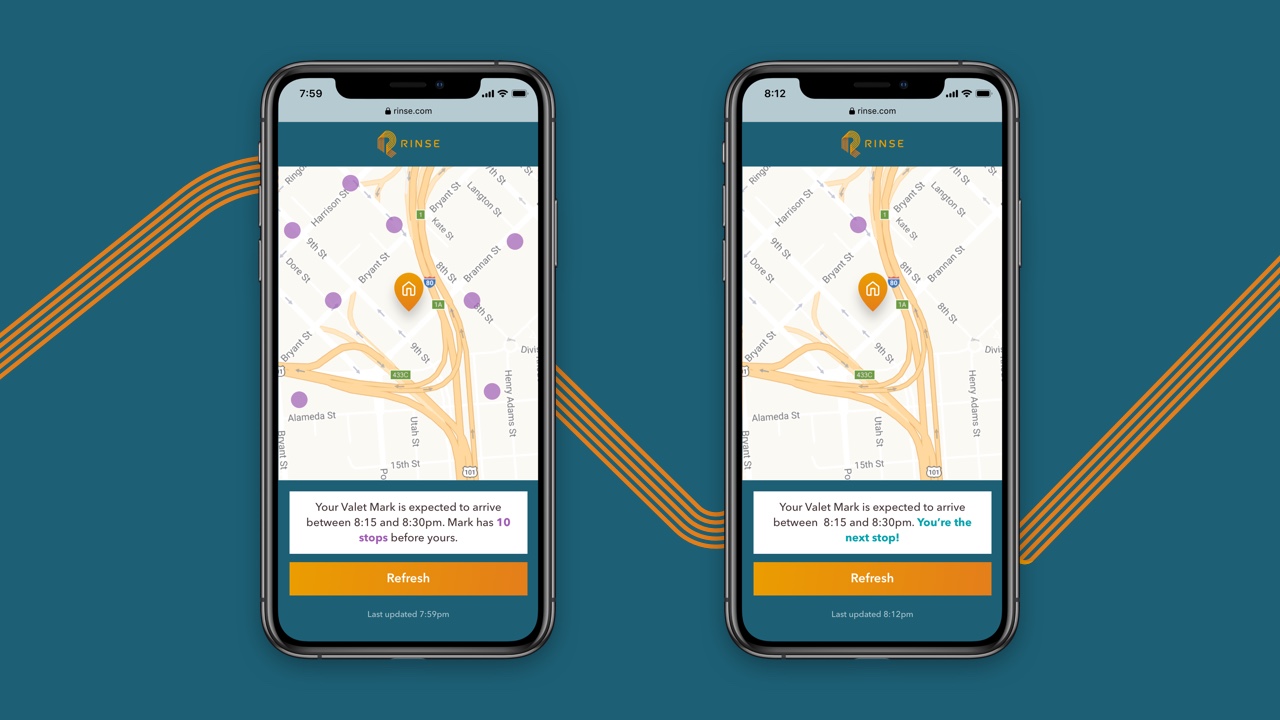
The Where Is My Valet feature is one that our team designed in response to customer feedback and feature requests. If you ever have an idea for how Rinse can be better, please share it with our team by contacting [email protected]. We review customer requests regularly and update our service to better serve our customer’s needs!
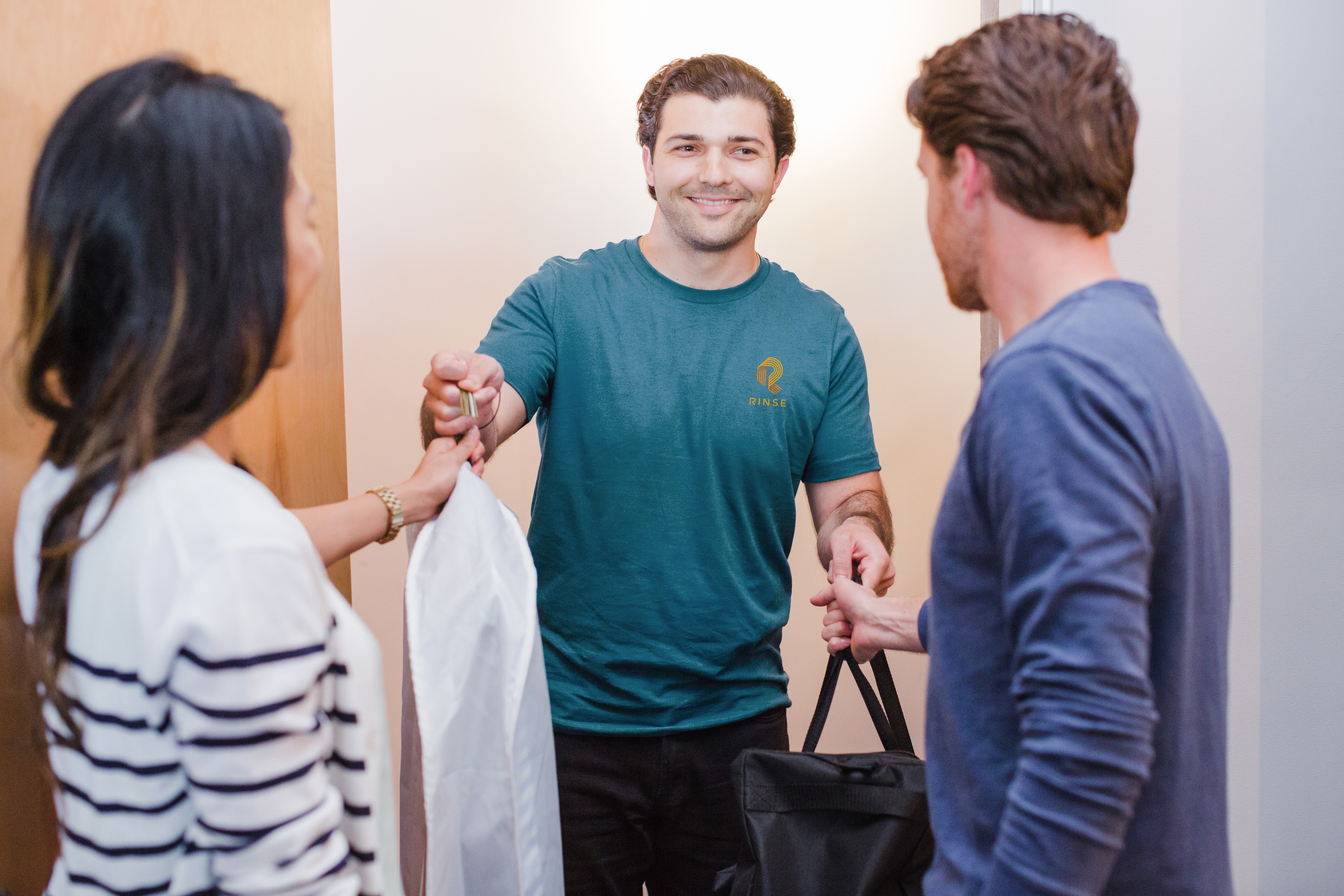
A question that we often receive is why Rinse only picks up and delivers orders between 8pm and 10pm. With other similar services like Instacart and Doordash delivering at all hours of the day, it’s a pretty understandable question.
The short answer: we maintain a two hour delivery window in order to save you money!
We're able to charge the prices that we do because we keep our operations as efficient as possible.
When you give us an item to clean, we pick it up, take it to our warehouse to check it in, take it to one of our cleaning partners, carefully clean it, pick it up from a cleaning partner, take it back to our warehouse to we can check it out to a Valet, and deliver that item back to your front door. That's a lot of travel for one dress shirt (or skirt, or suit, or whatever). The only way that doesn't cost our customers major dollars is because we do everything we can to streamline operations. Our consistent 8pm to 10pm delivery window is just one of about 15 tactics that make up our secret sauce for smooth and affordable operations.
We’re able to execute the same operations each day in batches rather than on a one-off basis which is much more efficient. For example, with order pickup and delivery, we're able to go from house to house in a certain neighborhood like a honey bee, picking up and delivering clothes in your area rather than ping ponging back and forth all over town throughout the day. Since we pay our Valets hourly, that makes a huge difference when it comes to cost savings, and we’re able to pass that along to our customers.
We choose the 8pm to 10pm window because that’s when most customers are home (though with Rinse Drop, customers don’t need to be) and because traffic has usually died down at that point, making it easier for our Valets to get where they need to go.
We’ve put a lot of thought into why we do things the way we do and we’re always happy to share with our customers. If you ever have any questions, just reach out to our helpful Care team at [email protected] or visit our FAQs.

Check out Rinse’s Co-Founders' episode of NPR’s How I Built This with Guy Raz as part of the Resilience Series.
Check out Rinse’s Co-Founders, Ajay and James, episode of NPR’s How I Built This with Guy Raz as part of the Resilience Series.
How I Built This is a very popular podcast about "innovators, entrepreneurs, idealists, and the stories behind the movements they built" produced by NPR. The Resilience Series focuses on Guy’s conversations with founders and entrepreneurs about how they're navigating turbulent times, including Airbnb, Hello Sunshine, DreamBox, and now Rinse!
In the episode, Ajay and James discuss with Guy how to start a business and choose the right Co-Founder, how Rinse’s business model works, and how Rinse’s core values have been guiding Rinse through the challenges of COVID-19. Download the episode or watch the full video interview below!
Download the audio podcast here.
Watch the video podcast:

Cleaning Service Reviewed, one of the leading independent review sites for cleaners around the world, has named Rinse as one of the Top 9 Best Dry Cleaners in San Francisco! Receiving this recognition would not be possible without the hard-work and dedication from our team at Rinse including our Valets, Cleaning Partners, Customer Care team, and all of our local Operations teams.
We appreciate the support of all of our customers, especially our customers in the Bay Area. We're proud to be recognized as one of the best dry cleaners in San Francisco and look forward to continuing to serve the San Francisco Bay Area for years to come!

Rinse partnered with Bags4Kids in March to help foster kids in need
Did you know that the vast majority of children entering foster care have to carry their belongings in garbage bags? There are more than 55,000 children in foster care in California today and due to limited financial means, Social Services cannot provide luggage to pack a child’s essential belongings before bringing them to a foster home. If no bags are donated, Social Services often uses trash bags out of necessity. It is tragic enough that a child has been abused or neglected, but to have all of his or her items put into trash bags can place a feeling of worthlessness on the child.
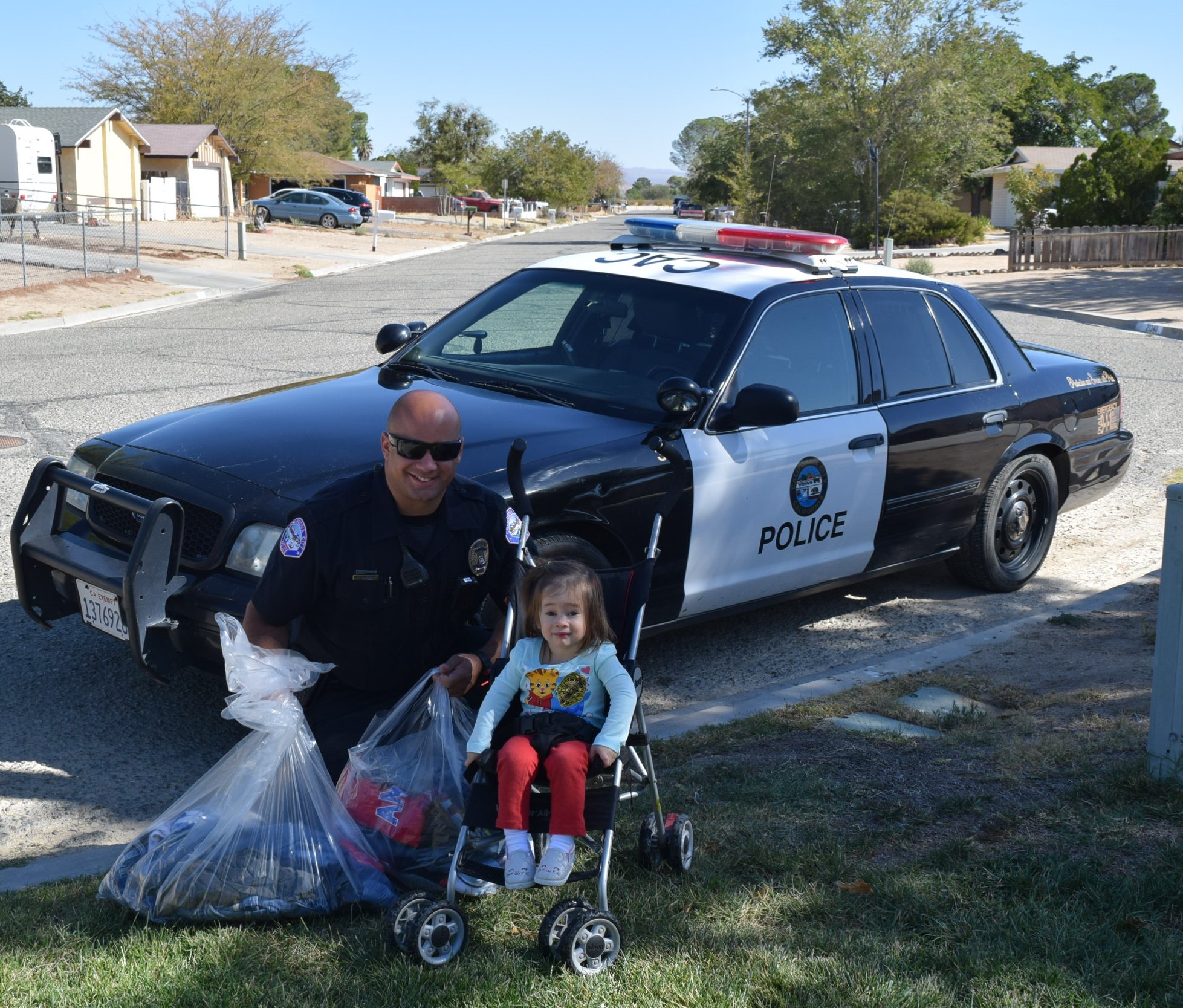
No child should feel like garbage, and no child should have to carry their belongings around in a garbage bag. That’s why Rinse is so proud to support and raise awareness for Bags4Kids, a southern California non-profit that provides foster children with “bags of hope.”
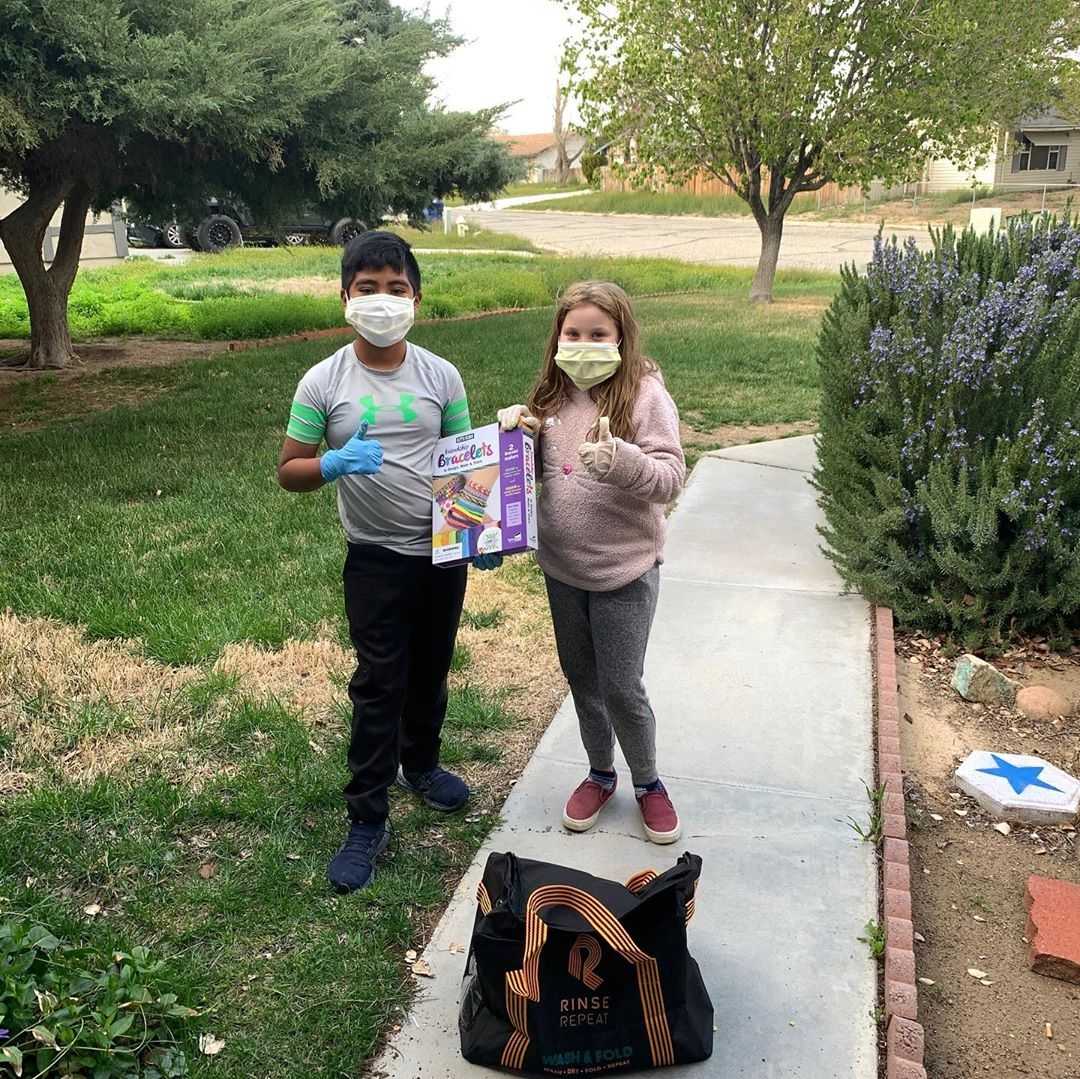
Bags4Kids and their work
The bags of hope that Bags4Kids provides are not just a means of transporting foster children’s possessions, but also include items of necessity and comfort to help these children during one of the most stressful periods of their lives.
Each bag of hope includes necessities that a child will need in their new home like a toothbrush and shampoo -- items they may not have had access to or been able to pack from their previous living situation. The bags also include items to bring them comfort and distraction as they adjust to their new home. Depending on the child’s age, the bags of hope can include items ranging from stuffed animals and other toys to art supplies, journals, books, and school supplies.

An opportunity to help
During the first week of March, 2020, Rinse was able to donate over 2,500 duffle bags to Bags4Kids to support their important cause.
If you’re familiar with our service, you know that we provide each customer with a premium duffle bag to use for their laundry. As we’ve grown, we’ve built up a very large supply and this spring we found a surplus of 2,500+ brand-new duffle bags. Through a member of the Rinse team, we learned about Bags4Kids, their incredible work, and their need for supplies -- including duffle bags!
Bags4Kids has already assembled and donated the first several hundred Rinse + Bags4Kids bags of hope to social service organizations and police stations throughout southern California. Even in the face of the coronavirus, Bags4Kids continues their work, providing comfort to some of the most vulnerable children in our community.

Make Mom Proud
Since our founding, one of Rinse’s core values has been to “Make Mom Proud.” We are so grateful and proud to support such a wonderful organization and raise awareness for their important work.
If you would like to learn more about Bags4Kids and how to support them, please visit https://bags4kids.org/.

This past Tuesday (9/10/19), California legislators approved a landmark bill that will require companies to treat contract workers as employees when the contractor's work is considered "part of the main business." In response, Uber declared that they were not subject to the new law because it does not consider its drivers to be at the core of their business.
At Rinse, we feel very differently about our Valets: they have always been at the core of our business and are at the frontlines of our customer experience. To that end, the new legislation doesn’t impact us at all because we have classified our Valets as W-2 employees since the very beginning (2013).
Read our CEO and Co-Founder Ajay Prakash's Forbes article from 2015 to learn more about why it's so important to Rinse that we invest in our Valets and classify them as employees since the beginning.
Forbes Article from July 15th, 2015
Over the past few years, there has been a growing debate around whether someone is an employee or independent contractor, particularly in “on-demand economy” companies that require a staff of drivers and other service providers to deliver their product or service to the end customer. The recent ruling by the California Labor Commission on how Uber should classify its drivers has re-ignited this debate. While I can’t opine on how other companies have decided to classify their workers, I wanted to provide perspective on how we formed our opinion on the subject at Rinse in case you are currently thinking about starting a company where delivery is core to its value proposition.
At Rinse, a critical part of the experience we’ve created for our customers is the interaction they have with our Valets (which is what we call our drivers) at the point of pick-up and delivery. Our Valets are on the front lines of the customer experience, so we made the decision to classify them as employees (“W-2”) early on. Depending on how you use your delivery staff, you might decide to take a different approach, but here are three reasons why W-2 status made sense for us — and why it could make sense for your drivers too.
It’s the Right Thing to Do
When starting a company, it’s imperative for founders to remove any friction that may stand in the way of getting their product to their customers to collect feedback. Given that, you want to spend less time early on agonizing over decisions like whether to classify your staff through W-2 or 1099 forms, and instead spend more time on actually serving your customers and improving your product. Even though classifying your drivers under 1099 status is quicker and cheaper (especially since you avoid payroll taxes), it’s important to understand what exactly your drivers will do and how they will do it. At Rinse, our Valets work less than 20 hours per week (which one person told me early on puts us in a “gray area” in the employee vs. contractor debate), but we provide them with a uniform, make their schedule, tell them where to go and when to go there, and supply them with most of their equipment. According to IRS guidelines, those are all indicators that W-2 status is most appropriate for them. If you expect your drivers to do similar things, you might draw the same conclusion that we did.
It’s Better for Your Drivers
Although W-2 status is more expensive for your company, it is much better for your delivery staff in the long run. Financially, they end up paying fewer taxes each year, are compensated for overtime hours and are reimbursed for each mile driven. More importantly, though, it signals to your drivers that they are a critical part of your team (which they are!). At Rinse, we invest enormous amounts of time in training our Valets so they have complete product knowledge to best serve our customers and the appropriate context to understand the importance of their role. This investment has led to better performance, happier valets and incredibly high levels of retention (and in some cases, Valets have been promoted into key roles on our customer experience and operations teams), and is an investment we would be less likely to make if we classified our Valets as merely contractors. As you think about building your team, consider using the W-2 status as a strong motivational tool to get the best out of your delivery staff.
It’s Better for Your Customers
Most importantly, investing in your delivery staff is ultimately better for your customers. One thing I’ve heard consistently from customers since our early days is that we have the friendliest and most competent delivery staff out there. This is because happy employees who really care about their company are more likely to go above and beyond to make sure their customers are happy. In addition, sending a consistent delivery staff to your customers only serves to increase the level of trust they will have in your brand and in your service. At least, that’s what we’ve seen at Rinse.
If delivery is core to your product offering, it’s worth your time to think through how you want to classify your drivers. If you’ve noticed the recent spate of lawsuits against delivery companies that have chosen to go the 1099 route, it might be wise to classify your drivers as W-2 employees today. That said, regardless of how the “W-2 vs. 1099″ debate evolves, make sure you take a people-first approach and take care of all your employees, especially your service staff like drivers, as they are often the main touchpoint for your customers. Remember, happy employees lead to happy customers, and ultimately you need happy customers to even be part of this ongoing debate.
Topics
Rinse Drop
We offer pickup and delivery if you can’t be present between 8pm and 10pm.
Our Valet will pick up or deliver your order to your doorstep or concierge, at which point you’ll receive a text with a photo showing where your items were left.
You can enable Rinse Drop on any (or all) of your orders.